What's Really Happening to Men After 40?

What's Really Happening to Men After 40?
Testosterone, sex, strength, stress and the health conversations we need to have.
Men have a remarkable ability to adapt to almost anything.
We work through difficult seasons, take on massive responsibilities, build careers, provide for our families and find ways to keep moving forward in incredible uncertainty.
And sometimes, without really noticing, we begin neglecting our own health.
We're not sleeping quite as well. Recovery takes a little longer. We've gained some weight around our middle. Our energy isn't what it used to be.
Perhaps our interest in sex has changed. Or we're noticing that our erections aren't as reliable as they once were.
These are deeply personal experiences, and I know some men find them difficult to talk about.
But they deserve a proper conversation.
Because too often, we accept these changes as an inevitable part of getting older without taking the time to understand what's actually happening.
Then, one evening, we Google testosterone replacement therapy.
The algorithms get to work, and suddenly we're seeing aggressive advertisements everywhere telling us our testosterone is dropping because we're over 40, and TRT might be exactly what we need.
Well, perhaps it is.
But wouldn't it make sense to look under the hood before deciding what needs fixing?
That's what I want to explore with you.
Medical concerns deserve proper assessment by qualified healthcare professionals. My focus, as a coach who's spent more than 16 years helping people transform their physical health, is on something that I believe deserves just as much attention.
How are we actually looking after and supporting the body we're asking so much from?
Before we blame testosterone, let's look at the bigger picture
I want you to think about the past 15 or 20 years of your life.
Perhaps you were an active young man. You played rugby, lifted weights, cycled or spent your weekends doing something physical.
Then life became wonderfully full.
You studied. Built a career or business. Fell in love. Raised a family. Took on responsibilities. Worked long hours and made sacrifices for the people and things that were important to you.
And somewhere along the way, your own physical health gradually moved further down the list of priorities.
You started sleeping less. Exercise became something you would get back to when things settled down. Meals became whatever was convenient. A few drinks at the end of a long day became a regular thing.
Perhaps you gained 10kg. Then another 10kg.
None of this necessarily happened because you actually stopped caring about your health. You were building a life and your focus and energy when to that.
Your body has been adapting to the conditions you've created for it all these years.
And now, in your 40s or 50s, you're wondering why you don't feel quite like the man you remember.
It's a perfectly reasonable question.
I just want us to investigate the right things before deciding on the answer.
I've written about some of the habits men develop while managing pressure in When Seeking Relief Starts Running Your Life. It's a conversation worth having with yourself.
What does looking under the hood actually mean?
When a man comes to me wanting to improve his physical health, I want to understand how he's living.
His training history, nutrition, sleep, body composition, work demands, stress and the habits that have developed over time.
I want to know what he's doing well, where he's struggling and which changes would make the greatest difference. What would move the needle for this man the most and the fastest.
Because very often, there are opportunities for meaningful improvement long before we need to consider anything particularly complicated.
Nutrition and body composition. Are you carrying substantial excess body fat? Are you eating enough nutritious food and protein? Is your current diet supporting your health and physical activity?
Strength and physical activity. Are you challenging your muscles regularly? Maintaining cardiovascular fitness? Moving throughout the day? Or has physical activity gradually disappeared from your routine?
Sleep and recovery. How much are you sleeping? Do you wake feeling rested? Are you recovering from training and daily demands? Could something like sleep apnoea be affecting your health?
Stress and daily habits. What does your working week look like? How are you managing pressure? What role do alcohol, nicotine, caffeine or other coping habits play in your routine?
General health. When last did you have your blood pressure, glucose, cholesterol and other relevant health markers assessed? Are there medical conditions or medications that might help explain what you're experiencing?
The answers to these questions can give us a clearer understanding of the man and the conditions his body is functioning under.
Now let me introduce you to someone who took those questions seriously.
Meet Ignus. A man who decided to investigate before he medicated.
Ignus came to me at 40 years old.
He works incredibly hard. The kind of man who puts in long days, takes his responsibilities seriously and has a work ethic I deeply respect.
But over the years, he'd developed habits that weren't doing his physical health any favours.
He'd also gained approximately 30kg.
Ignus testosterone results were low, and TRT was being discussed.
But before committing to treatment, he decided to contact me.
I remember our first conversation.
"So, Ignus, are we going for a six-pack?"
He laughed.
I understood why.
Here was a man carrying considerably more weight than he wanted to, working himself into the ground and wondering how on earth he was going to turn things around.
And here's his new coach asking him about a six-pack.
But I wanted him to start seeing what might be possible. To reach for something that inspires him again and in his case with my experience i knew it was possible. That is also a coaches job, to raise our ambitions.
So we had a serious conversation about his health, lifestyle and the changes we could begin making.
We decided to focus on those fundamentals first while his health continued to be assessed by his doctor.
We worked on his nutrition, establishing an appropriate calorie deficit while ensuring sufficient protein to support lean muscle.
We introduced structured resistance training at home, because Ignus lives on a farm and needed a programme that worked with his circumstances.
We incorporated cardiovascular exercise, daily movement and recovery.
And perhaps most importantly, we built a routine he could sustain alongside his demanding working life.
And yes, he had to make space and there were sacrifices.
Consistency was incredibly important.
A brilliant programme that a man cannot realistically follow is of very little use to him.
Ignus lost an extraordinary 27kg.
His body composition changed dramatically. His strength and fitness improved, and so did his confidence and overall sense of wellbeing.
For me, the most rewarding part was watching him take ownership of his physical health and discover what he was capable of.
But there's another part of his story I want to share.
When Ignus returned to his doctor and repeated his blood work, his testosterone levels had improved substantially.
In fact, the improvement was so striking we joked that he must have somehow cheated on the test!
Now that was a conversation I loved.
Because it reinforced something I've seen throughout my career: meaningful changes to the way we live can have an extraordinary influence on our physical health.
The precise hormonal response varies between men, and Ignus's remarkable transformation isn't a prediction of what all man will experience of course.
But his story is an excellent example of why a thorough investigation is important before we consider more complex solutions to early on.
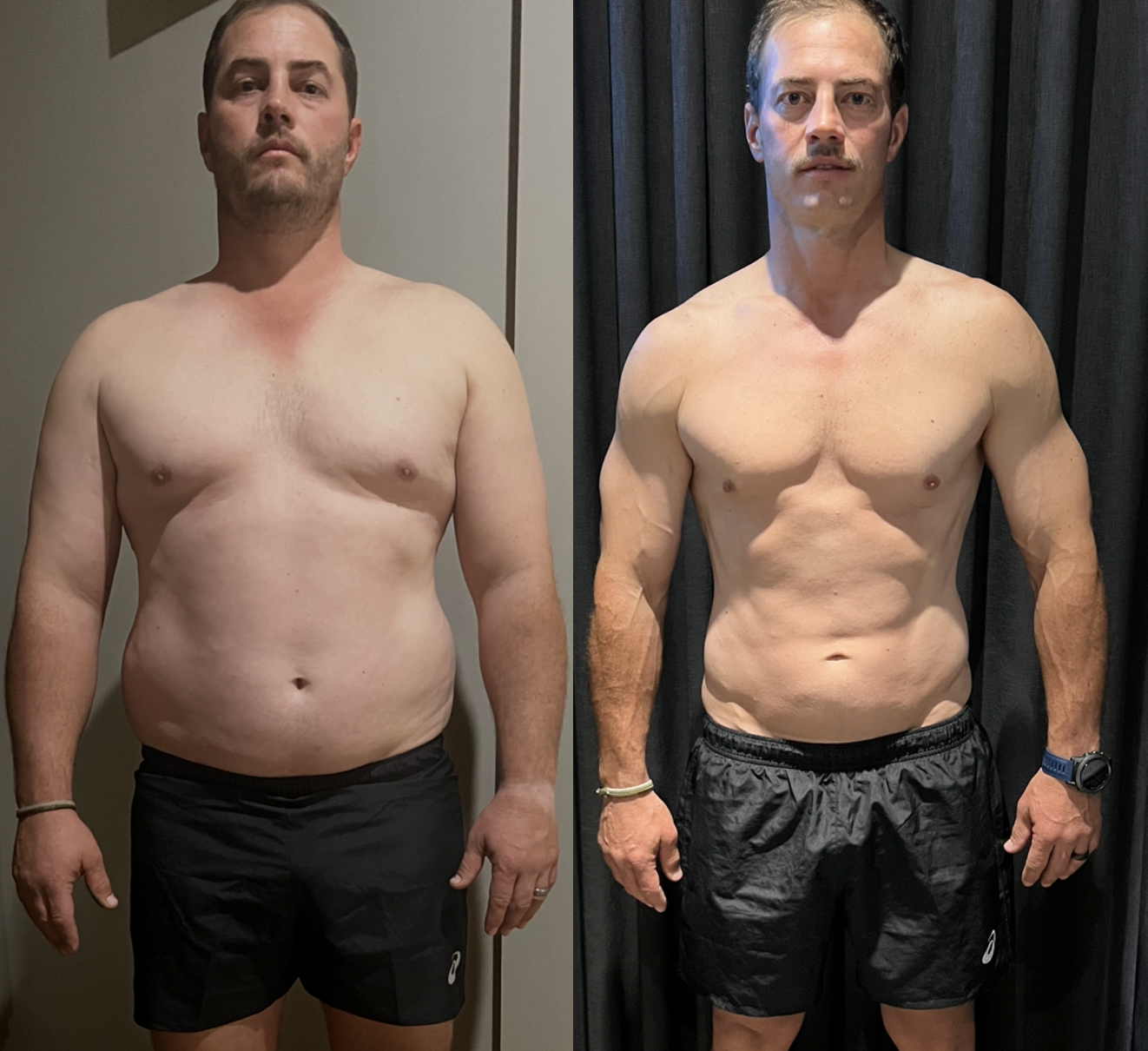
Ignus, 40. A 27kg transformation over 12 weeks, alongside improvements in his physical health and subsequent testosterone results.
Turning 40 is not a medical diagnosis
There's no switch that flips on your 40th birthday.
You don't suddenly wake up with low testosterone, a broken metabolism, weak erections and an urgent need for sensible shoes.
But our bodies do change as we get older.
Muscle can become harder to maintain if we're no longer challenging it. Recovery deserves more attention. Certain medical conditions become more common, and the effects of years of inactivity, excess body fat, inadequate sleep or sustained stress can become increasingly noticeable.
Yet men don't all age in the same way.
I know men in their 60s who are physically strong, active, energetic and enjoying fulfilling sex lives.
I also know men in their late 30s who are exhausted, struggling with their weight and wondering what happened to their physical vitality.
Age alone doesn't explain those differences.
Our genetics, health conditions, environment, habits and life circumstances all influence how we experience ageing.
Getting older is inevitable. But not every decline in health is an unavoidable consequence of age.
Let's talk about testosterone
Testosterone is an important hormone in men's health.
It contributes to sexual desire, muscle and bone health, red blood cell production and several other physiological functions.
Levels can gradually decline as men age, although the extent varies considerably.
Body composition, metabolic health, illness, certain medications and other factors can also influence testosterone levels.
Feeling tired does not automatically mean you have low testosterone.
Neither does gaining abdominal fat, struggling to recover from exercise or experiencing changes in your sex drive or even quality of erection.
These symptoms can have multiple causes.
A large European study involving men aged 40 to 79 identified three sexual symptoms particularly associated with lower testosterone: fewer morning erections, reduced sexual thoughts and erectile difficulties. But symptoms alone without other considerations are not enough for a diagnosis.
The Endocrine Society's 2026 statement emphasises the need for appropriate symptoms together with consistently low testosterone levels measured accurately.
We want to understand what's happening in the body, not simply chase a number on a laboratory report taken once.
Sex, libido and erections. Let's talk about it.
I believe men deserve to be able to discuss their sexual health with the same maturity and openness as any other aspect of their wellbeing.
An erection is a normal physiological function. So is sexual desire.
Changes in either can be deeply personal, particularly when they begin affecting a man's confidence or intimate relationships.
And there's something important we need to understand.
Libido and erections are related, but they are not the same thing.
Libido is your desire for sex.
An erection is a physical response involving blood flow, nerves, hormones and the brain.
A man may have a strong desire for sex but struggle to achieve or maintain an erection.
Another man may experience reliable erections but little sexual desire.
As we get older, some men notice changes in spontaneous morning erections, the time required for arousal or the period needed between sexual encounters.
There's no universal standard for how frequently a healthy man should want sex or how his sexual response must compare with another man's.
What matters is understanding meaningful changes in your own health.
Occasional erectile difficulties are common. Persistent or worsening problems deserve medical attention.
The European Association of Urology's guidance identifies connections between erectile dysfunction and conditions such as diabetes, hypertension, vascular disease, hormonal disorders and psychological factors.
Erectile dysfunction can sometimes be an early indication of cardiovascular problems.
So a change that a man might privately experience as a loss of confidence could actually be valuable information about his health.
Your ability to achieve an erection does not determine your masculinity. But changes in your erectile health are worth understanding.
And whether the underlying factors are physical, hormonal, psychological or relational, they deserve the same respectful attention.
Your stress is not separate from your physical health
I work with men who carry significant responsibilities. These responsibilities often bring enormous meaning to a mans live.
They can also place considerable demands on us.
We understand that stress affects our thoughts and emotions. But sustained stress, together with inadequate sleep, poor recovery and unhealthy coping habits, can also affect our physical wellbeing.
A 2026 scientific review examining stress, testosterone and sexual function explored the complex relationship between stress, hormonal regulation and sexual health.
The research suggests that physical and psychological stress can influence testosterone and sexual function through several different pathways.
Importantly, stress can affect sexual desire and erections even when testosterone levels are normal.
Sleep deserves particular attention.
In a small controlled study published in JAMA, restricting healthy young men's sleep to five hours per night for one week reduced daytime testosterone levels by approximately 10–15%.
The study was small, and we shouldn't assume every man will experience the same response.
But the broader message is valuable.
Sleep and recovery are important parts of maintaining good physical health.
If you're consistently working late, sleeping poorly, eating on the run, relying on caffeine and nicotine to keep going and using alcohol to unwind, there are several important areas of your health worth examining.
And you may be surprised by how much better you can feel when you begin supporting your body properly.
I've explored the demands men carry in The Pressure to Provide: When Men Lose Themselves in the Life They're Building.
Your muscle is worth protecting
Now we're talking about something particularly close to my heart.
I've spent much of my professional life helping people build stronger, healthier bodies.
And the older I get, the more deeply I appreciate the value of physical capacity.
I want men to look good and feel confident in their bodies.
But building and maintaining muscle is about far more than impressive biceps or a six-pack.
Muscle supports strength, movement, metabolic health and our ability to remain physically independent as we age.
It contributes to our capacity to travel, enjoy physical activities, play with our children or grandchildren and continue participating fully in life.
A review of 50 clinical trials found that resistance training can improve strength and physical performance in older adults, including those experiencing age-related muscle loss.
That's encouraging.
And it reinforces something I tell my clients regularly.
We need to train for the life we want to live, not simply the body we want to see in the mirror right now.
Progressive resistance training, sufficient dietary protein, appropriate nutrition, cardiovascular fitness and recovery should remain important throughout adulthood.
We also need to be intelligent about how we manage body fat.
Some men need to lose considerable weight to improve their overall health.
Others are already lean and active but consistently under-eating, training excessively or failing to recover.
The answer isn't always to train harder or eat less.
The answer is to understand what your body needs and build a plan that supports it.
So, what should a man investigate?
If you've noticed persistent changes in your energy, libido, erections, mood, strength or physical performance, I encourage you to arrange a proper medical assessment.
Understanding your health gives you the opportunity to make better decisions.
Depending on your symptoms and medical history, your doctor may consider blood pressure, glucose, cholesterol, sleep health, medications and investigations for conditions such as thyroid disease or anaemia.
If testosterone deficiency is suspected, clinical guidance generally recommends at least two separate early-morning, fasting testosterone tests, interpreted together with symptoms and other findings.
Additional testing may help determine whether low testosterone is related to the testes, hormonal signalling from the brain or other health factors.
At the same time, I want you to look carefully at the areas of your lifestyle that you can influence.
Your body composition. Nutrition. Physical activity. Strength. Sleep. Recovery. Stress and daily habits.
For many men, meaningful improvements can begin with these fundamentals.
For others, the investigation may identify a genuine medical condition requiring treatment.
Either way, we've moved from guessing to understanding.
And that's massive progress.
Where does testosterone replacement therapy fit in?
Testosterone replacement therapy, or TRT, is a legitimate prescription treatment for appropriately diagnosed testosterone deficiency.
It can improve certain symptoms, particularly aspects of sexual function, and may positively affect body composition in suitable patients.
But it is a treatment for a medical condition, not a general solution to every challenge men experience as they age.
Some men have permanent hormonal disorders that require ongoing treatment.
Others may have low testosterone associated with potentially reversible conditions, including significant excess body fat.
This is why understanding the underlying cause is so valuable.
The Endocrine Society recommends weight loss as the usual first-line treatment for men whose testosterone deficiency is associated with overweight or obesity and who have no other identified cause.
Where medical treatment is indicated, the decision should involve a clear discussion of expected benefits, potential risks and appropriate monitoring.
TRT can suppress the body's natural testosterone production and sperm production, which is particularly important for men who may wish to have children.
Other considerations include red blood cell concentration, cardiovascular risk and individual health conditions.
A large cardiovascular safety trial provided reassurance regarding major cardiovascular events during its study period, while also identifying safety concerns that require appropriate assessment and monitoring.
We will explore all of this in greater detail in the next article in this series.
For now, I want you to remember something simple.
The objective isn't to get onto TRT or to avoid TRT. It's to understand your health well enough to know what treatment, if any, you genuinely need.
High performance means looking after the man who has to live your life
As I've moved into my 40s, my understanding of performance has continued to evolve.
It's easy to measure success through the things we achieve.
Our careers, businesses, financial security, homes and the opportunities we create for our families.
And these things are of course all important and adds fulfilment to our lives.
But there's another question I so should also ask
What is the quality of the life you're actually experiencing inside the body that carries you through your life?
Are you sleeping well?
Do you have the strength and physical capacity to do the things you love?
Are you enjoying intimacy and meaningful relationships?
Are you recovering from the demands of your life?
Do you feel physically and emotionally equipped for the future you're building?
My capacity work looks at six interconnected areas: Regulation, Recovery, Physical Systems, Cognitive Load, Emotional Processing, and Identity & Meaning.
Together, these offer a way of considering the whole man and the conditions that influence his capacity to live well.
Because our physical health doesn't exist separately from everything else we're experiencing.
And as I explored in You've Built a Life. Now Build the Man Who Gets to Live It, we deserve to be able to enjoy the lives we've worked so hard to build.
What I want you to take from this
If you're in your late 30s, 40s, 50s, 60s or beyond, I want you to become genuinely interested in understanding your health.
Pay attention to the changes you're experiencing.
Ask good questions. Have the necessary medical assessments. Understand your results.
And take a serious look at the things within your control.
Your nutrition, physical activity, muscle mass, body composition, sleep, recovery and the habits that shape your daily life.
Don't underestimate the value of getting these fundamentals right.
And don't assume that needing medical treatment somehow means you weren't adequate to look after yourself. There could genuinely be an issue.
Taking ownership is about recognising what you can influence, making responsible decisions and getting the right support when you need it.
I believe every man's greatest chapter are still be ahead of them. The future is where it's at, the now is where it's built and where fulfilment comes from.
I want you to have the health, strength and capacity to enjoy it.
We've got a lot more living to do, gentlemen.
Let's make sure we're looking after the man who's going to live it.
Your Brother & Friend,
Jacque Visagie
MEDICAL DISCLOSURE: This article forms part of Men's Health & Vitality, a MEN | GREATER LIVES series on men's physical health, hormones, sexual wellbeing, strength, nutrition and healthy ageing. It is provided for educational purposes and does not constitute individual medical advice. Medical symptoms, investigations, diagnoses and treatment decisions, including TRT, should be discussed with appropriately qualified healthcare professionals. Individual experiences and outcomes, including client transformations, are not guarantees of similar results.
Explore A Few Articles
My thoughts on identity, pressure, relationships and building a life from your values.